Employee Benefits Under the Spotlight: Legislative Changes Effective 1 January 2027
In the Czech Republic, approximately 80% of employees receive some form of employee benefit. Benefits and cafeteria programmes have become a standard part of employee compensation packages and are highly valued by prospective employees.
New legislation introduces further changes from 1 January 2027 for companies and their employees. Hopefully, these changes will be for the better, following the measures introduced by the previous government in 2024 as part of its fiscal consolidation package.
According to data from Edenred, as many as 80% of HR professionals across Czech companies consider employee benefits an essential part of remuneration. Benefits are also an important tool for motivating employees, recruiting new talent and improving retention.
Employee benefits have long since moved beyond meal vouchers. Today, they cover leisure activities such as culture and sport, education, health and support for employees at different stages of life and in various personal circumstances. They provide comprehensive support to help employees eat well, look after their health, stay active, relax, pursue education and access advice when facing challenging life situations.
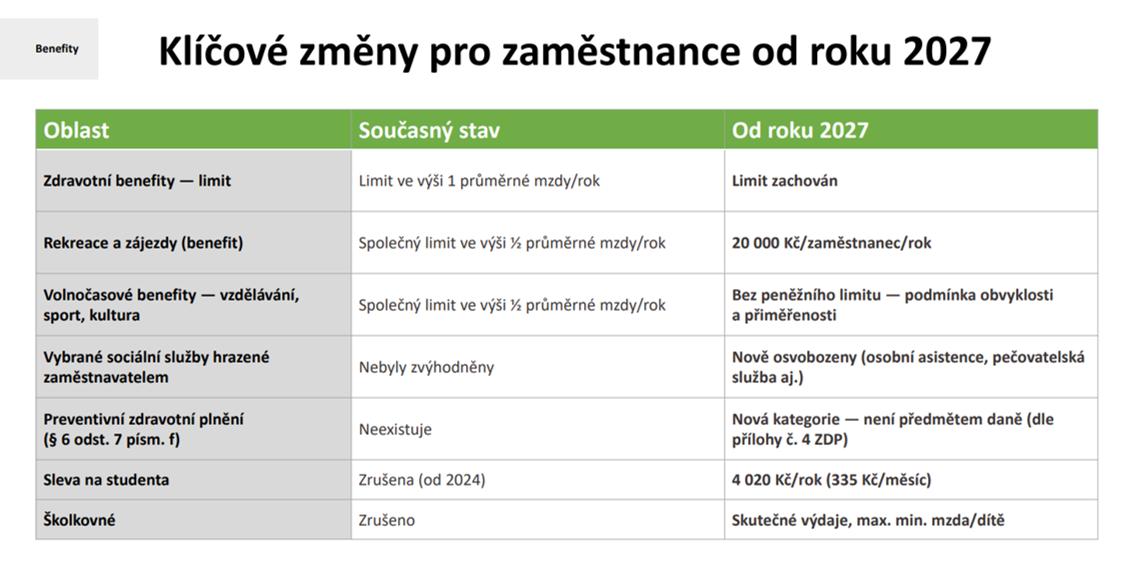
According to experts, the changes taking effect in January 2027 should reduce the administrative burden on companies by removing the overall cap on leisure benefits. Employers will no longer have to monitor and calculate cumulative limits for each employee. However, before January 2027, companies will need to review their payroll systems and internal policies and ensure that everything complies with the new rules.
One advantage is that employers will once again be able to offer more generous benefit programmes and non-cash benefits.
An interesting development is the introduction of social benefits, designed to support employees caring for loved ones, particularly ageing or ill parents. It is clear that caring for older people often requires support from relatives and family members. Many people find themselves becoming informal caregivers, often unexpectedly and not entirely by choice, having to balance their jobs with caring responsibilities. Over time, this can be extremely exhausting, both physically and mentally. It also affects household finances and caregivers' own economic circumstances. The demands of caregiving may force people to change jobs, reduce their working hours or accept positions below their qualifications simply to manage both responsibilities. Informal caregiving frequently affects women aged 45–65, giving the issue a significant gender dimension, with further consequences for career progression, the gender pay gap and other areas.
As people are expected to remain in employment for longer while maintaining their wellbeing, employee health is becoming an increasingly important consideration for companies. The tax-exempt limit for health benefits will remain equivalent to the average wage. However, a new category of selected preventive medical examinations and vaccinations (such as additional health check-ups and screenings) will be excluded entirely from the existing limits and will not be treated as taxable income.
Employees are also likely to welcome the changes, as they will be able to access greater financial support for personal development and health. They will also gain access to tax-advantaged contributions towards caring for loved ones, such as personal assistance services or day care centres. Only recreational benefits will remain subject to an annual cap of CZK 20,000.
Further details can be found in the attached presentation from a webinar organised by the Comp&Ben Association in cooperation with the Czech Chamber of Commerce, with the support of Edenred, a Gold Signatory of the Diversity Charter.
Key Takeaways:
Read more about how employee benefits contribute to diversity here: How Employee Benefits Can Support Diversity and Inclusion

BPS – Byznys pro společnost, z. s.
V Tůních 1357/11, 2nd floor
Praha 2, 120 00
Tel.: +420 739 717 789
info@byznysprospolecnost.cz
www.byznysprospolecnost.cz
Co-funded by the Rights, Equality and Citizenship Programme of the European Union