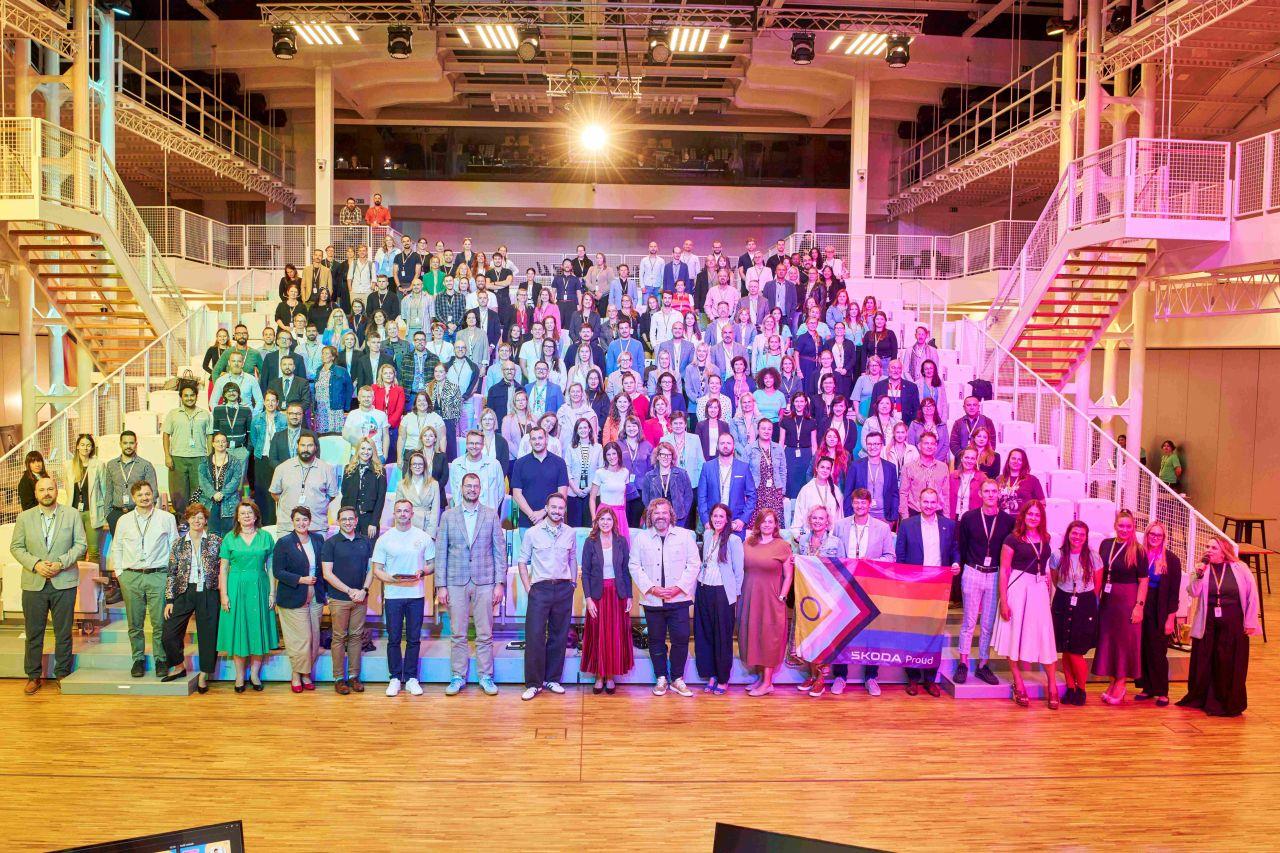
On 17 September 2026, a conference focusing on the experiences of LGBTQ+ people in manufacturing companies took place in Mladá Boleslav. The event was organised by Škoda Auto, a.s. in cooperation with Pride Business Forum and the Business for Society alliance, in the beautiful setting of the Škoda Auto Museum.
At a time when diversity, equity and inclusion are once again being questioned and downplayed, it is particularly valuable to see a large and influential company address such an important topic. This is especially true for LGBTQ+ issues, which still remain on the margins of attention in many companies. Škoda Auto deserves considerable recognition for taking this step.
Leading by Example
When an employer of Škoda Auto's stature publicly commits to diversity and inclusion, it helps pave the way for other companies as well. It demonstrates good practice, sets a direction and becomes a source of inspiration for other businesses, employees and the wider public. This is precisely where responsible companies have a crucial role to play: not being afraid to stand firmly by their values, even in turbulent times.
“I don't have a problem with gay and lesbian people, but…”
The position of LGBTQ+ people has never been easy, and although much has changed, there is still a great deal of work to be done. The figures speak for themselves:
50% of LGBTQ+ people prefer to conceal their sexual orientation or identity at work
31% have experienced discrimination or harassment because of their sexual orientation or identity
88% of such incidents were never reported
62% of LGBTQ+ people are concerned that their sexual orientation or identity could negatively affect their careers
This is far from an ideal situation. While the majority population commonly reports a high level of tolerance, research among LGBT+ people themselves shows that the reality can be quite different. And tolerance is by no means the same as respect or genuine understanding.
In the Czech Republic, we often hear the phrase “But I tolerate them.” Yet tolerance, acceptance and respect are three different things. They differ in the level of personal acknowledgement, emotional attitude and recognition we extend to another person. In the context of LGBT+ issues—as in human relationships more generally—they represent three distinct levels:
Tolerance means acknowledging a fact or situation even if I do not agree with it. I may not be comfortable with it, but I do not actively oppose it. A typical attitude might be: “I have nothing against gay and lesbian people, as long as they don't shove it in my face.” We tolerate a minority, but expect it to remain invisible.
Acceptance goes a step further. It means accepting reality and recognising that people are different and society is diverse, without trying to change the other person. “I understand that you are different. It's your life, and you are part of our society.”
Respect means actively recognising another person's value, individuality and rights.
Persistent prejudice also has a very real impact on the mental health of LGBTQ+ people. According to research by the National Institute of Mental Health, up to half experience mental health difficulties, depression or anxiety. A quarter report suicidal thoughts or behaviour, which is five times the rate found among the heterosexual population. As previous research has also shown, these disparities are not caused by sexual orientation itself, but to a large extent by social stigma, discrimination and a lack of acceptance.
This is also reflected in the story of Mariana, an employee at Škoda Auto. She went through a gender transition from male to female, and her journey towards living as herself was long and extremely difficult. At one point, she even came close to feeling that it might be better to end everything. Fortunately, her story ultimately took a positive turn, thanks in large part to the strong support of her colleagues and the open and welcoming environment she found at Škoda Auto.
Personal experience plays a crucial role. When people personally know someone from the LGBTQ+ community—whether in their family, at work or among friends—the level of acceptance rises significantly, reaching as high as 90%.
The Reality Across Czech Companies
Approaches to LGBTQ+ issues vary considerably across the Czech corporate environment. For large and multinational corporations, LGBTQ+ inclusion is generally an established part of their diversity and inclusion strategies. They often have well-developed internal policies, equalised employee benefits and established employee resource groups. The situation is more complex in smaller Czech companies and traditional industries. The topic is not unknown, but companies often tend to avoid addressing it.
According to data from the Confederation of Industry of the Czech Republic, more than 80% of larger companies actively address diversity. However, the reality for individual employees is much more complicated, as more than half of LGBT+ people in the Czech Republic still conceal their sexual orientation in the workplace.
Coming out can be particularly difficult in the manufacturing sector. People are often less concerned about having to leave their employer and more worried about discrimination, microaggressions, inappropriate jokes or damaged relationships with colleagues.
This is precisely why it is so important for responsible companies, working together with expert and non-profit organisations, to actively promote a culture of openness, respect and democratic values. By doing so, they clearly demonstrate that diversity and inclusion have a firm place both in the workplace and in society as a whole—and that everyone should have the opportunity to fulfil their potential regardless of their background, age, gender or other differences.
Josef Maršálek, a renowned Czech baker and pastry chef and one of the distinguished guests at the conference, summed it up best: we should not make it into something dramatic or unusual, but simply treat it as a normal part of life. We should foster workplaces where people feel comfortable being open about their sexual orientation or identity—because LGBTQ+ people are simply part of our society and, statistically, they are all around us. Including in your company.
Newsletter
Odebírejte náš newsletter a neunikne vám nic ze světa Charty diverzity a udržitelného rozvoje.
Contact

BPS – Byznys pro společnost, z. s.
V Tůních 1357/11, 2nd floor
Praha 2, 120 00
Tel.: +420 739 717 789
info@byznysprospolecnost.cz
www.byznysprospolecnost.cz
Co-funded by the Rights, Equality and Citizenship Programme of the European Union