Smart Recruitment – How Training Centres Save Time and Costs
Last week, in the beautiful setting beneath the Tatra Mountains, we met with representatives of BEKO to take a closer look at their long-term successful model of employing the Roma community at the Poprad plant. Today, this approach is rightly regarded as one of the most striking examples of how inclusive policies in companies do not have to be only a matter of values, but can also be functional, economically meaningful and sustainable in the long term.
When You Can Try the Job First
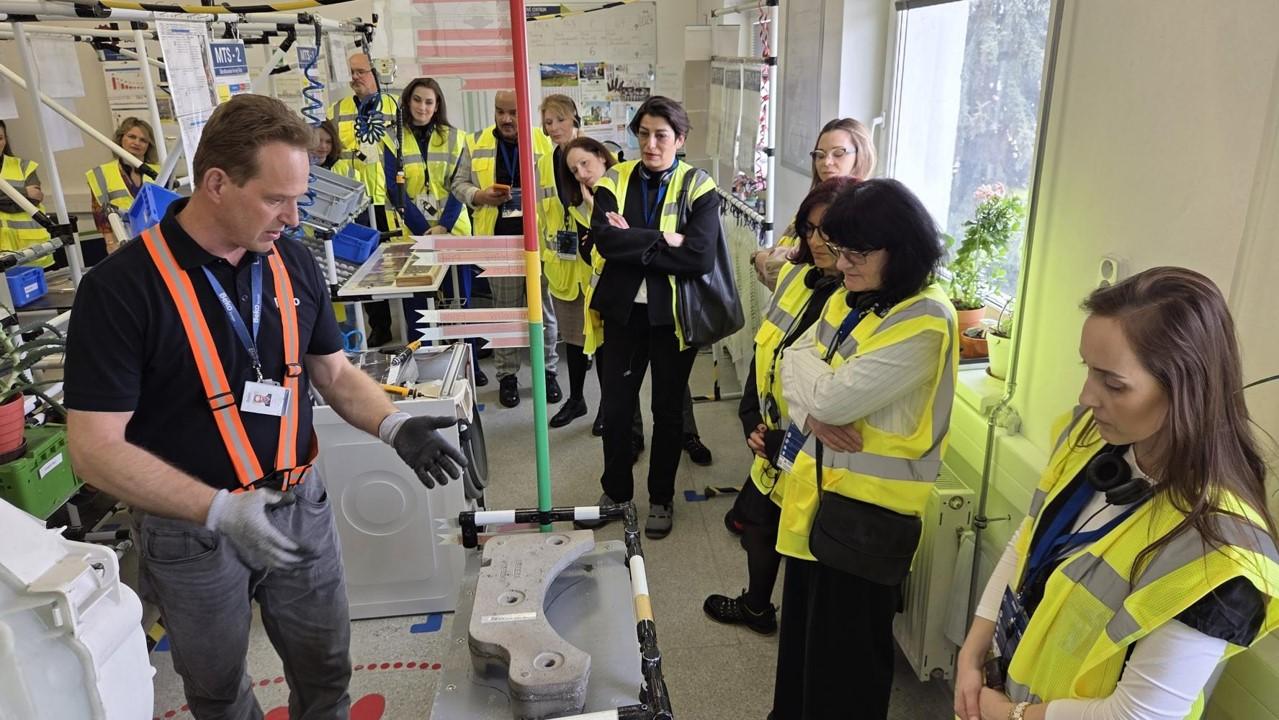
An important element of success is also a well-developed system of employee training and adaptation. A key role is played by training centres, which allow applicants and employees to acquire the necessary skills in an effective and practical way.
One of the training centres is open to the wider public and job applicants. Here, they can try out the most common production tasks and very quickly find out whether the job suits them and whether they are able to handle it manually. It also includes practical “tests”, during which applicants complete specific tasks within a time limit. This approach brings benefits to both sides – the company and the candidate quickly find out whether the cooperation is a good fit. The result is savings in recruitment and onboarding costs, as well as significantly lower turnover during the probation period, because employees know exactly what they are signing up for.
“I was very impressed by the training centres and the overall employee care system. It is clear that when a company invests in people and gives them opportunities, it gets that back in the form of loyalty and long-term cooperation. The average length of employment of 16 years is clear proof of that,” says Lucie Fuková, Government Commissioner for Roma Minority Affairs.
Employee Development and Production Flexibility
The second, adaptation-focused training centre is intended both for newly hired operators and for existing employees. New workers are systematically and thoroughly prepared here for their future role, which significantly speeds up the adaptation and onboarding process while also helping reduce errors in production.
For existing employees, the centre offers space to expand their skills and competences. Thanks to this, they can handle a broader range of activities, which gives the company greater flexibility and the ability to respond quickly to current demand. At the same time, it enables rotation of workers between individual positions, helping prevent long-term monotony and one-sided physical strain. The result is higher employee satisfaction, stronger motivation for further development, and an overall more stable and efficient working environment.
Safety First – Practical and Easy to Understand
An integral part is also occupational safety and fire protection. Here too, BEKO uses an interactive form of training that allows employees to learn the rules in practice, not only in theory. This approach increases not only workplace safety, but also employees’ overall engagement.
Measurable Benefits for the Company and the Region
BEKO Manufacturing Slovakia in Poprad has long demonstrated that if a company creates an open working environment, active recruitment and systematic support during adaptation, it can offer job opportunities even to people who are often excluded from the labour market. More than 30% of employees here are of Roma origin. This is not just a one-off project, but a well-thought-out long-term strategy.
BEKO’s experience clearly confirms that inclusive employment brings not only social impact, but also concrete benefits for the company and the region. Among the most significant are greater team stability, support for regional employment and a reduction in social exclusion.
"Jaroslav Grygar and his team at Beko Europe in Poprad have been proving for several years that it is possible to successfully employ people from socially excluded Roma communities. This approach requires both financial resources and human capacity, which is why many companies eventually step away from it. What is clearly missing for other relevant employers to join is systemic support from the state. Only in this way can short-term projects move towards long-term integration,” says Ivana Vagaská, Executive Director of Business Leaders Forum Slovakia.
BEKO’s experience can therefore be a strong source of inspiration especially for manufacturing companies in the Czech Republic. It shows that inclusion is not only a matter of social responsibility, but also of smart and effective management that delivers concrete results.
Newsletter
Odebírejte náš newsletter a neunikne vám nic ze světa Charty diverzity a udržitelného rozvoje.
Contact

BPS – Byznys pro společnost, z. s.
V Tůních 1357/11, 2nd floor
Praha 2, 120 00
Tel.: +420 739 717 789
info@byznysprospolecnost.cz
www.byznysprospolecnost.cz
Co-funded by the Rights, Equality and Citizenship Programme of the European Union